April 24, 2026 • Mara Voss • 9 min reading time • Prices verified June 5, 2026
Titanium Wedding Bands: The Lightweight, Hypoallergenic Case for Skipping Tungsten
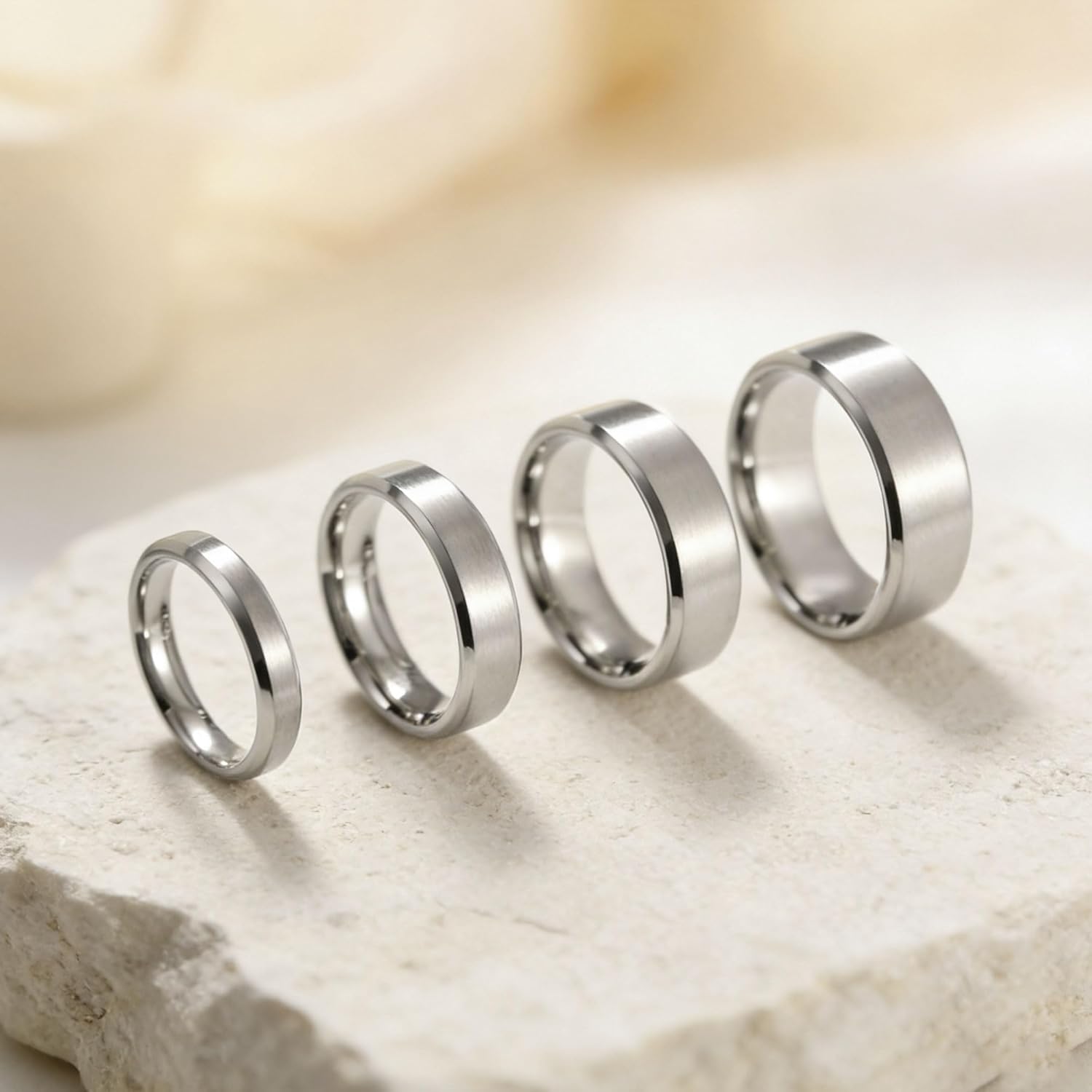
Titanium is a metal — the same material used in surgical implants and aerospace components — that has found a serious home in the wedding band market over the last decade. In jewelry terms, it is prized for three qualities that overlap almost perfectly with what a lot of modern couples actually need: it is dramatically lighter than steel or tungsten, it is naturally hypoallergenic (meaning it will not trigger the skin reactions that nickel-containing metals sometimes cause), and it is strong enough to handle a working person’s daily routine without cracking or deforming. If you have been researching alternative metal bands for a while, you probably already know titanium’s name. This article is for the buyer who is past the introductory overview and now needs to make a real decision — specifically whether titanium beats tungsten for your situation, what the actual trade-offs look like on paper, and which buyer profile each metal genuinely serves.
What Titanium Actually Is — and Why the Grade Matters
Not all titanium is the same alloy, and the grade distinction matters more for jewelry buyers than most product pages let on.
Grade 1 and Grade 2 are commercially pure titanium — essentially unalloyed. They are softer, slightly more workable, and used in entry-level bands where cost is the priority. They scratch somewhat more readily than higher grades.
Grade 5 (Ti-6Al-4V) blends titanium with 6% aluminum and 4% vanadium. It is the aerospace standard, and it hits a Vickers hardness around 300–350 HV — meaningfully harder than pure grades. Most mid-range and specialty titanium jewelry uses Grade 5 or its medical variant.
Grade 23 (Ti-6Al-4V ELI) is the implant-grade medical version of Grade 5, with tighter controls on interstitial elements. Per Titanium Industries’ material data sheets, Grade 23 is the specification used for surgical implants, which is why jewelers marketing to buyers with documented metal sensitivities often call out this grade specifically.
The GIA’s educational resources on alternative metals note that titanium’s oxide layer — a thin, stable film that forms spontaneously on the surface — is what blocks ion release and makes it inert against skin tissue. This is not a coating that wears off; it self-repairs when scratched. That distinction matters when you are comparing it to, say, a stainless steel band whose hypoallergenic claim depends on nickel content being kept below a legal threshold, rather than on the underlying chemistry of the metal.
By the numbers — titanium vs. tungsten carbide:
| Property | Grade 5 Titanium | Tungsten Carbide |
|---|---|---|
| Density | ~4.5 g/cm³ | ~15.6 g/cm³ |
| Vickers Hardness | ~300–350 HV | ~1,200–1,500 HV |
| Mohs (approx.) | ~6 | ~9–9.5 |
| Resizable? | Yes (limited) | No |
| Emergency removal | Standard cutting tools | Requires ring cracker |
Density is where the lifestyle argument begins and ends. Tungsten is roughly 3.5× heavier than titanium at the same volume. On a 6mm band, that weight difference is perceptible the moment you put both on your hand. For surgeons, athletes, or anyone who wears gloves, handles equipment, or simply finds jewelry distracting, that gap is not trivial.
The Scratch-vs.-Shatter Trade-Off, Stated Plainly
This is the decision frame that matters most for an intermediate buyer who has already read the surface-level comparison articles.
Tungsten carbide’s hardness — around 1,200–1,500 HV on the Vickers scale — means it resists surface scratches almost completely under normal wear. A year of daily use and a tungsten band typically still looks polished. That is the headline tungsten sellers lead with, and it is true.
The failure mode tungsten sellers bury is brittleness. Tungsten carbide is a ceramic composite, not a ductile metal. Under sudden impact — dropping the ring on tile, catching it on a hard edge — it can crack or shatter. More practically for active-lifestyle wearers: if a tungsten band gets caught on machinery or compressed in a sudden hand injury, it cannot deform the way metal does. Emergency room removal requires a ring cracker, not standard ring cutters. Brides.com’s wedding band metal guide and JCK Online’s retailer coverage have both documented this as a persistent aftermarket service issue — hospitals and ERs need to be equipped for it, and not all are.
Titanium’s trade-off runs the opposite direction. At 300–350 HV, Grade 5 titanium will accumulate surface scratches over time. It is not fragile — it bends rather than shatters under impact, and standard ring-cutting tools can remove it in an emergency. Jewelers can also re-polish a scratched titanium band, which is not an option with tungsten once the factory finish is gone.
The decision rule here is straightforward:
- If you work in an environment where hand injuries, heavy equipment, or crush risk are realistic, titanium’s ductility and emergency-removability are not marketing language — they are safety features.
- If you want a band that looks pristine for five years without maintenance and your daily environment is low-impact, tungsten’s scratch resistance is a real advantage you will notice.
- If you are somewhere in the middle — active lifestyle, occasional rough work, but not high crush-risk — titanium is the more forgiving default.
The Knot’s wedding rings buying guide frames this as “scratch-resistant vs. shatter-resistant,” which is probably the cleanest shorthand in circulation.
Hypoallergenic: What That Word Actually Guarantees (and What It Doesn’t)
“Hypoallergenic” is not a regulated term in the United States jewelry market. It is marketing language that signals low allergen risk, not zero risk. The GIA’s educational resources are explicit on this point, and it is worth understanding what distinguishes titanium’s claim from a steel band also labeled hypoallergenic.
Nickel allergy is the most common contact dermatitis reaction in jewelry. The EU’s REACH regulation sets a nickel release limit of 0.5 micrograms per cm² per week as the threshold for jewelry in prolonged skin contact — a standard that gives you something concrete to ask about when a seller says their steel is “nickel-safe.”
Titanium — particularly Grade 23 — contains no nickel. It does not release ions that are known allergens. The oxide layer that forms on its surface is chemically inert in biological environments; this is why the same alloy is used in orthopedic implants and dental fixtures. Jewelers Mutual’s guidance on alternative metal rings notes that titanium is among the safest choices for buyers with documented metal sensitivities, alongside niobium and platinum.
For comparison: stainless steel (316L) is low-nickel but not nickel-free — it contains roughly 10–14% nickel by composition, controlled to minimize release, not eliminate content. Most wearers have no reaction, but buyers with confirmed nickel allergies are taking a calculated risk with steel that they are not taking with implant-grade titanium.
If hypoallergenicity is a primary requirement rather than a nice-to-have, the material hierarchy is: Grade 23 titanium > niobium > 316L stainless steel, with tungsten carbide sitting in a complicated middle position that depends heavily on the binder used in manufacturing (cobalt-bonded vs. nickel-bonded tungsten have very different allergen profiles).
Personalization, Inlays, and Where Titanium Has Limits
For buyers in the $200–$500+ range considering specialty finishes, titanium opens real design doors — but closes a few others worth knowing about.
What works well with titanium:
- Anodization, the process of thickening the oxide layer through electrical current to produce vivid, dye-free color (blues, purples, golds, greens) without paint or plating. Specialty jewelers including Lashbrook and some Benchmark configurations use this process specifically on titanium, since it is not possible on tungsten or cobalt chrome.
- Inlay work: carbon fiber, wood, antler, and meteorite inlays seat well in titanium channels. The metal’s workability relative to tungsten means a craftsperson can actually machine precision channels, adjust tolerances, and rework the piece if an inlay needs resetting.
- Matte, brushed, and sandblasted finishes that complement an industrial or natural aesthetic.
Where titanium runs into limits:
- Resizing is technically possible — unlike tungsten, which cannot be resized at all — but the options are constrained. Titanium cannot be soldered the way gold can; a jeweler typically sizes up by stretching or cutting and re-welding, which affects finish integrity. Many titanium bands are effectively “order the right size” purchases. JCK Online’s retailer coverage notes that exchange policies rather than resizes are the dominant solution in the titanium market, which means verifying a retailer’s exchange window before you buy matters more here than with gold.
- High-polish finishes show fingerprints and fine scratches more visibly on titanium than on tungsten. If a mirror finish is the priority, tungsten holds that look longer.
- Plating (yellow gold, rose gold) does not bond as durably to titanium as it does to softer metals. Jewelers who specialize in titanium tend to steer buyers toward anodized color rather than plated color for this reason.
The Matching-Set and Non-Traditional Couple Angle
Titanium’s weight symmetry — both partners wearing a band that feels like almost nothing — has made it a consistent choice for couples who want a genuinely coordinated wearing experience, not just a visually matched set. This matters more than it sounds: a 6mm tungsten band on one partner’s hand and a 4mm titanium band on another creates a perceptible weight asymmetry that some couples find strange; a matched titanium set at the same width simply feels the same on both hands.
For non-traditional couples, LGBTQ+ partners, and buyers deliberately stepping outside the gold convention, titanium’s design flexibility — anodized color, unconventional widths, matte finishes, inlay combinations — allows for genuinely distinct aesthetics that still coordinate. The anodization color palette in particular is impossible to replicate in any other alternative metal at comparable price points.
The Clear Decision Rules
If you are still weighing titanium against tungsten (or steel or cobalt) after reading this, here are the clean “if X, then Y” frames:
If you work in a high-impact or crush-risk environment: Choose titanium. Emergency removability is not optional, and tungsten’s brittleness is a documented clinical issue, not a theoretical one.
If your primary priority is scratch resistance and you have a low-impact daily routine: Tungsten wins on that single metric. Acknowledge you are trading resizability and repairability to get it.
If you have a confirmed nickel allergy or documented metal sensitivity: Grade 23 titanium is the safest choice in this metal category without moving to platinum or niobium. Do not accept “hypoallergenic stainless steel” as an equivalent.
If you want anodized color, complex inlays, or a band a specialty jeweler can actually work with over time: Titanium is the right platform. Tungsten forecloses most post-purchase customization and all resizing.
If you are buying a coordinated set and want the physical wearing experience to match: A same-width titanium set is the cleanest answer currently available in alternative metals.
Per Jewelers Mutual’s guidance, regardless of metal choice: confirm your retailer’s exchange policy in writing before purchasing any alternative metal band. Resizing is a real limitation across this entire category, and exchange windows — typically 30 to 90 days — are your practical safety net.